
Making sure you stand out from the crowd: developing a value proposition

Share This Article
This insight is one of a series on key ideas in strategy, based on the book by =mc consulting directors, Bernard Ross and Clare Segal – The Strategy Workout, (Financial Times/Pearson, Autumn 2015).
Value Proposition: are you worth it?
A value proposition is a way of encapsulating what your unique offer is. It goes beyond a simple slogan to explore how an agency – whether commercial or charity – adds value to a customer, donor, beneficiary or service user. A value proposition can cover a whole company, a team or even an offering – a service or product.
Value propositions are common parlance now in the business world where competition is fierce and explicit. They are essential in the world of venture capital where your venture capitalist will ask you to make sure your elevator pitch starts with this. We’ve adapted a VC model below to provoke your thinking.
But until recently they have been less common in the charity and public sector. Maybe because of a reluctance to acknowledge the increasingly fierce competition for wallet share and mind share among supporters. That’s starting to change. And this download should help you develop your own value proposition.
We’ve consciously chosen to use a number of commercial examples as well as not for profit ones. Partly since they are more readily understood sometimes – but also because many charities we’ve worked with like to guard their VP like the Coca Cola secret. (So can you work out what UNICEF’s VP is?)
What is a VP?
Ironically it’s easier to say what a VP is not that what it is. So it’s not a slogan or strapline.
So this is not a value proposition: L’Oreal. Because you’re worth it. And nor is this Domestos: kills 99% of all known germs fast.
A value proposition is a bit more complicated and follows a specific logic explored below.
Why is it important in charities?
Value propositions are important to charities for a number of reasons:
- Donors are increasingly exploring why they should support you rather than another similar cause – whether it’s in the WATSAN, child development, poverty reduction, environmental, educational or health field. (So why NSPCC versus Bernardos?)
- If you don’t have a VP then this may be a rationale to explore why you should merge and in that way add value – at least by economies of scale. (So in the UK two large breast cancer charities recently merged to achieve this result.)
- In an international dimension ‘disintermediation’ is increasingly a key issue. So many governmental and institutional donors are investing directly in projects ‘on the ground.’ They are questioning how much value an INGO adds in return for an overhead of 15% or more.
A value proposition helps address these internal and external issues.
Six Questions to answer in your VP
There are many ways to define a value proposition. In our experience a good way to shape and organise one is to consider the following six elements.
1. This value proposition is aimed at…
Who are the target users – supporters, donors, customers and services users?
2. Who are dissatisfied with…
Who is their current alternative provider (if any) for this broad area?
3. The offering we want to provide is…
What is your proposed offering (service or product)?
4. That provides this specific benefit…
What is the key benefit or payoff that your offering provides?
5. And solves this specific challenge…
What is the key problem solving capability your offering provides?
6. We are unlike others you might compare us to…
Who might your target market compare you to and how would you distinguish yourself?
So you might like to try answering this for, say, UBER, the fast growing taxi service. What’s your version of their value proposition?
- The UBER value proposition is for…
- Who are dissatisfied with…
- The offering is…
- That provides this benefit…
- And solves this challenge …
- We are unlike…
(See the end of this article for my answer* and compare it to yours.)
How to come up with an innovative value proposition?
You may realise that your current offerings are very much ‘me too.’ So for example the child sponsorship mechanic is very much a ‘me too’ one with say World Vision, SoS, Plan and Action Aid among others. All of these agencies have been for some time exploring how to come up with a new proposition. It’s not easy. Or in the same way you may want to set up a new food franchise or a hotel chain. How do you come up with a brand new proposition?
One framework to do this is to see it as part of an innovation process consisting of three elements.
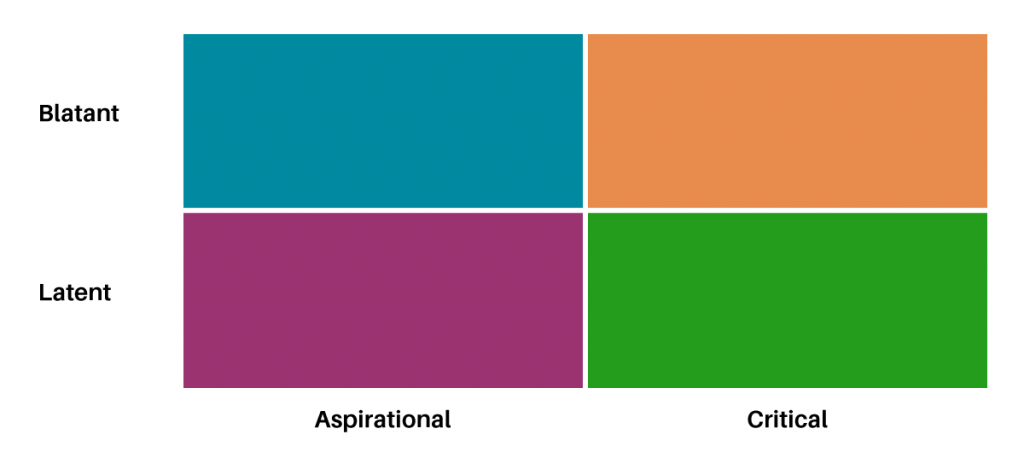
A good latent example to build on is Uber. So until Uber came along no one really thought that there was a need for an app that would allow you to simply order a taxi on your iPhone. The taxi model worked. But as soon as you realise you can access a cab almost anywhere, and get a price for it, andpay for it without cash, and get a journey time estimate why would you ever stand in a taxi rank again?
Likewise in the charity world Kiva identified the latent desire for donors to feel like social investors. Its success was based on a sudden unleash of value for people who wanted to do more than simply donate.
Aspirational could be a service that you’d like to have. So a first or business class cabin in an aircraft might be aspirational to a bundled holiday proposition. You arrive there in 7 hours regardless of where you sit. But business ‘feels’ aspirational for holidaymakers.
You might in a charity setting aspire to be part of a high value club or group – for example a Director’s Group at a theatre. Many charities offer special ‘privileges’ to higher value donors.
Critical might be the case if there’s a certain regulatory framework that you have to fit into. Fitting in adds value. So in the UK recent legislation means a service to help you plan pension provision for employees is critical if you’re an employer.
Ice bucket in some ways became a ‘must do’ proposition thanks to Facebook.
Blatant might beEvernote and its value proposition. The company set out to “help the world remember everything, communicate effectively and get things done.” So they appealed to a need to have everything organised in one place.
In the charity world blatant might be an emergency appeal that you feel you have to take part in. The need is so obvious and direct it demands a response from you – or perhaps Comic Relief.
Consider your offering. Which category does it fit in? How much value does it really add? Do your donors feel they you add value?
My Uber answer:
- The UBER value proposition is for people who want a low cost reliable taxi service on demand
- Who are dissatisfied with conventional cabs – over priced metered ones or unreliable and ‘dodgy’ mini-cabs
- The offering is an on demand reliable service at an affordable price available on your smartphone
- That provides the benefit of enabling people to use cabs more easily and more readily
- And solves this challenge of waiting, having cash, and worrying.
- We are unlike regular cab firms and we work worldwide.
Further reading and resources
And if you’re keen to know more about the thinking behind Uber here’s a great little video.
And if you’re keen to know more about the VC model of value proposition there are some great videos here.
How to find out more
=mc consulting team has worked with many of UK agencies on building up earned income or commercialisation.
We’re proud to be helping or have helped International Aids and HIV Alliance, RSPCA, NSPCC, National Theatre, National Housing Federation, NHS South East Commissioning Unit, Hull University, Bournemouth Water, Hackney Learning Trust, Plymouth City Council, Rotherham MBC and East Lindsey District Council.
If Red Ocean Blue Ocean sounds interesting and if you’d like to find out more about it or strategic development generally then =mc consulting can help you consider how or what to change.
Don’t miss out on the latest thinking.
Keen to receive the latest insights on fundraising, strategy, commercial awareness and decision science? Join the =mc consulting ideas forum and we’ll deliver leading edge advice and info on limited access events to your inbox.
Clare Segal, Director

The =mcconsulting family of websites


Our preferred training partner
